
Benton County Arrest Records and Court Charges
An arrest record is the record of the arrest itself. It notes who was taken in, the arresting agency, and the booking at the Benton County Sheriff's Office. Booking can include fingerprints, a photograph, a property inventory, and a warrant check. An arrest, on its own, is only an accusation. It does not mean a charge has been filed, and it does not mean a person was found guilty of anything.
The court charge record begins later. After an arrest, the prosecutor weighs the evidence and decides the formal charges. Those charges are filed with the court clerk, where they become part of the public case file. The custody and booking side sits with the sheriff, so the jail roster and booking detail belong on the Benton County inmate records page. Charges after arrest are tracked through the case, and the full case file with its outcome lives on the criminal court records page.
Who Files Benton County Charges After an Arrest
Three roles get confused often. The arresting agency makes the arrest. The prosecutor decides and files the charges. The court clerk keeps the record. Felony charges in Benton County are prosecuted by the Third Circuit District Attorney's Office, which serves Benton, Calhoun, Chickasaw, Lafayette, Marshall, Tippah, and Union counties. The elected District Attorney is Ben Creekmore. Staff assignments and contact details appear on the office's attorney profiles page, which names the prosecutor handling local cases.
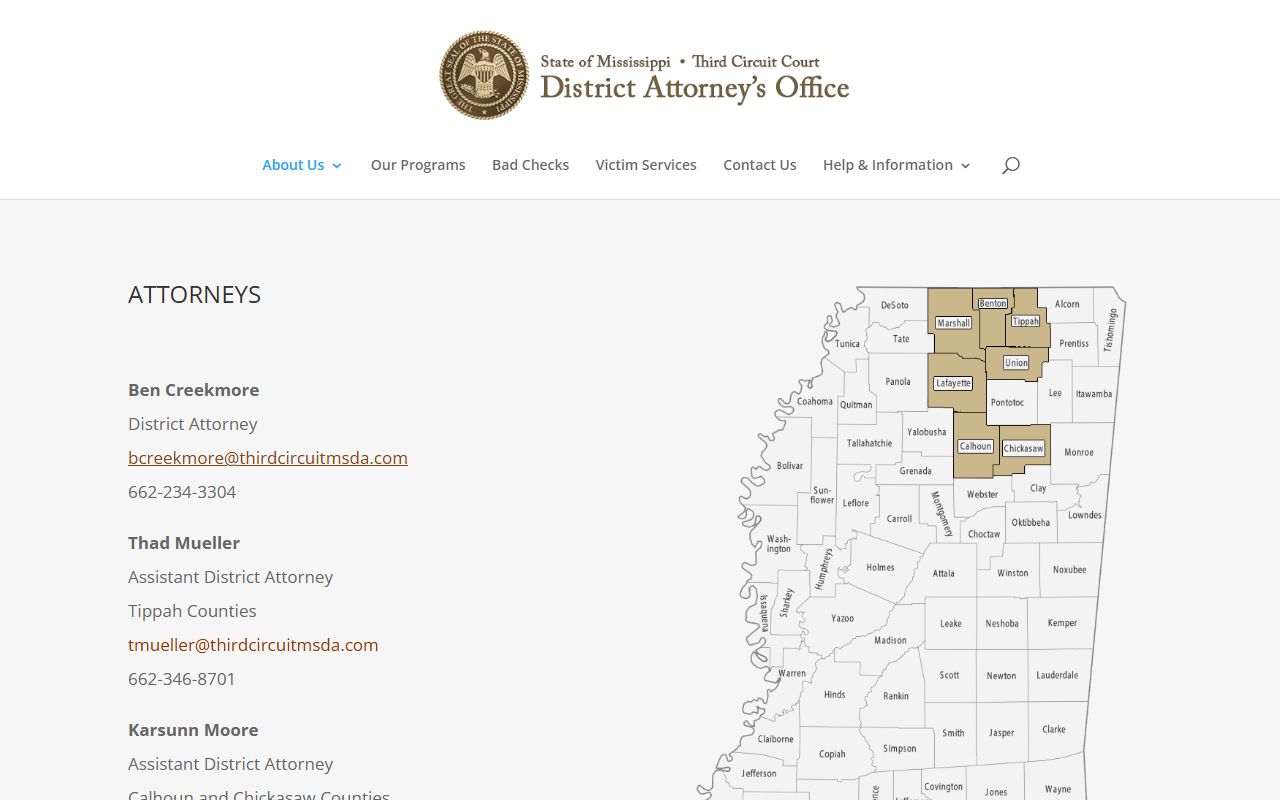
The Assistant District Attorney for Marshall and Benton County is Erika "Regan" Pritchard, and the investigator for the two counties is Jeremey Rainey. The District Attorney is not a clerk and does not hand out neutral case records. The office charges felonies, presents cases to the grand jury, negotiates pleas, and recommends sentences. For copies of the filed charge record, the request goes to the clerk, not the prosecutor.
People who cannot afford a lawyer have a right to appointed counsel. Mississippi runs the Office of State Public Defender, which supports trial-level defense across the state. No Benton County public defender office was located in official sources, so the practical step is to ask the judge for appointed counsel at the first appearance or arraignment.

For directory help, the office keeps a find a public defender page maintained by the Division of Public Defender Training. The page explains that listings are gathered from local defenders, so coverage varies by county.
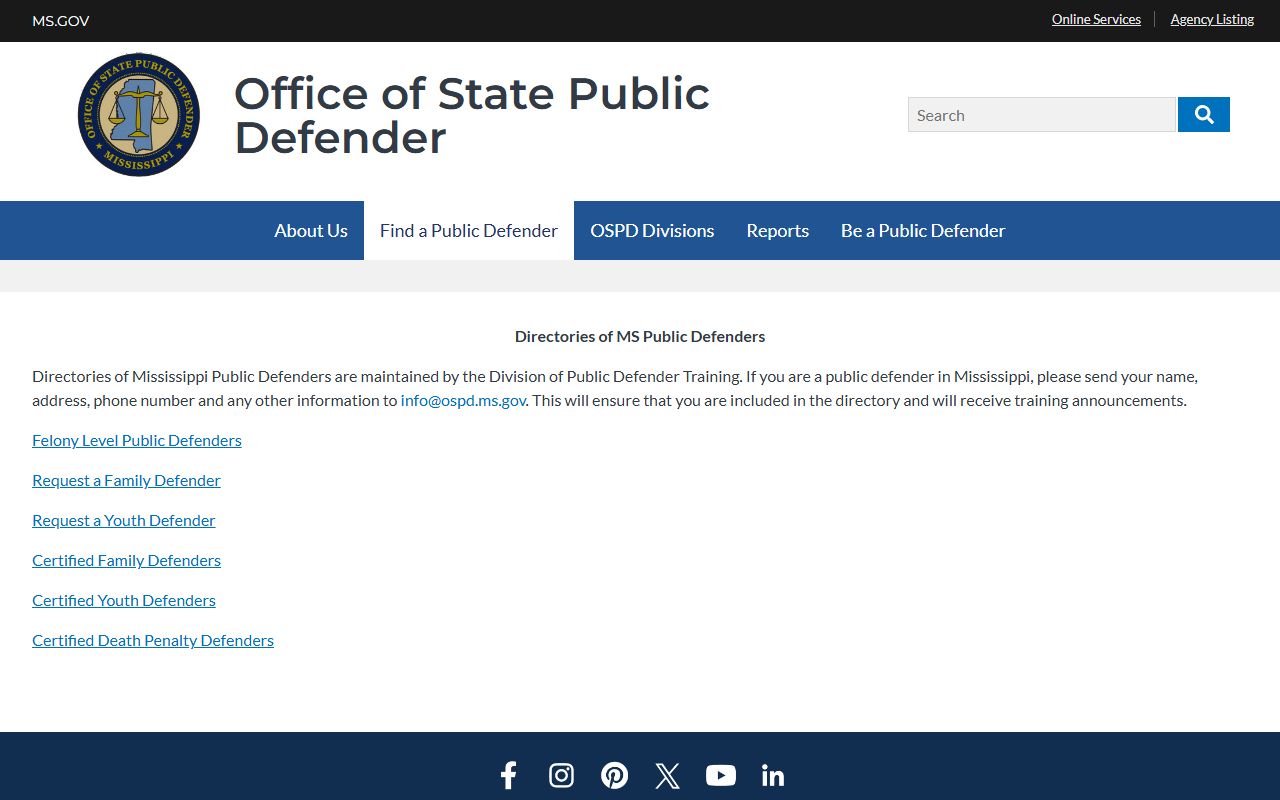
When a directory entry is missing, the local court is the fastest route to find assigned counsel.
How to Find Benton County Arrest Records
Charges and charge status show up in the court case file, not in a booking blotter. Benton County Circuit Court and Chancery Court both run on Mississippi Electronic Courts, the statewide case system. Felony charges live in Circuit Court, so the criminal charge record is a Circuit file held by the Circuit Clerk. Public remote viewing runs through PAMEC and carries a small fee, while arrest and booking detail stays with the sheriff.
- Open the Mississippi Electronic Courts portal and confirm the court reads Circuit Court of Benton County.
- Register for public access through PAMEC if you need to view documents from home; the news release lists a roughly ten dollar annual fee and twenty cents per page viewed.
- Search by defendant name or by case number, then open the matching criminal case.
- Read the charge list and check each charge's statute code, level, and current status.
For older files, sealed matters, or certified copies, call the Benton County Circuit Clerk at 662-224-6310. The clerk is the record custodian for felony charges, jury records, and judgments, so the counter and the phone line handle anything the online system does not show. Chancery cases also appear in a free Delta Computer Systems search, though criminal charges sit on the Circuit side.
Benton County Charging Documents
The charge record starts with a charging document. An arrest happens at booking, and then the case becomes a court matter only when the prosecutor or grand jury files the formal accusation. Mississippi uses three main charging documents. The type depends on how serious the offense is and which court holds the case. A complaint or affidavit often opens a misdemeanor, while serious felonies in Circuit Court usually move forward by grand jury indictment.
| Complaint | Information | Indictment | |
|---|---|---|---|
| Filed By | Officer or prosecutor | Prosecutor | Grand jury |
| Common For | Misdemeanors | Some felonies | Serious felonies |
| Typical Court | Justice or Municipal | Circuit | Circuit |
| Starts | The case | The case | The case |
Each document lists the specific offense, the statute it falls under, and the count or counts charged. One arrest can lead to several counts. The charging document is the anchor of the whole case record, and every later filing, from the plea to the disposition, ties back to it.
Circuit Charges vs Justice Court Charges
Where a charge lands depends on its level. Benton County splits criminal work across court tiers, and the file follows the charge. Felony charges are Circuit Court matters held by the Circuit Clerk. Misdemeanors and traffic offenses usually start in Justice Court or in a municipal court. The flow runs from the lower courts upward: Justice or Municipal Court, then Circuit Court on indictment or appeal, then the Mississippi Court of Appeals.
Justice Court handles small claims, misdemeanor criminal cases, and traffic offenses across the county. The official Benton County pages name Justice Court judges Brody Childers and Gary McBride but do not publish a direct Justice Court phone line, so the county main number 662-224-6300 is the practical contact. Municipal charges from Ashland, Hickory Flat, or Snow Lake Shores may not show in a Circuit or Chancery search. When a ticket or ordinance case began in a town, the municipal clerk holds that charge record.
A felony can begin as a misdemeanor-style complaint and then move up after a grand jury returns an indictment. That is why a single arrest can leave a trail across more than one court level.
Benton County Charge Status Terms
Charges change as a case moves. A charge can be amended, reduced, added, dropped, or dismissed, and the docket records each shift. Reading the current status matters because an old charge listing may no longer reflect what the defendant actually faces. The terms below appear often in Mississippi criminal files.
| Status | What It Means |
|---|---|
| Pending | The charge is filed and active, with no final outcome entered yet. |
| Amended / Reduced | The charge was changed, often to a lesser offense or a different count. |
| Dismissed | The charge was dropped by the court; with prejudice it cannot be refiled, without prejudice it can. |
| Nolle Prosequi | The prosecutor chose not to pursue the charge, ending it for now. |
A dropped or dismissed charge can still appear in the record unless it is later expunged. The docket shows the history, so a charge marked nolle prosequi or dismissed remains visible as part of the case timeline.
Note: a charge marked dismissed or reduced changes the legal exposure, but the original entry usually stays on the docket as a matter of record.
Charge Codes and Severity Levels
Every charge ties to a statute. The charging document cites a Mississippi Code section, and that citation is the charge code. The code fixes what the offense is and sets the range of punishment. Reading the code tells you more than the plain-language label, because two charges with similar names can carry very different penalties.
Mississippi sorts offenses by severity, and the level decides which court and which charging path applies. The main levels break down like this.
- Felony: serious crimes prosecuted in Circuit Court, usually by grand jury indictment.
- Misdemeanor: lower-level offenses commonly handled in Justice or Municipal Court.
- Traffic and ordinance violations: citations and local-rule cases that route to Justice or municipal courts.
One arrest can produce several separate charges at once, and they will not always share the same level. A case may pair a felony count with a misdemeanor count, each with its own code and its own status.
Charges vs Convictions
A charge is not a conviction. Being charged means a prosecutor has accused a person of an offense. A conviction means the case was proven by a guilty plea or a verdict. Both are public record, but they sit at very different points in the process and carry very different weight.
| Charge | Conviction | |
|---|---|---|
| Stage | Accusation | Verdict or plea |
| Burden of Proof | Probable cause | Beyond a reasonable doubt |
| Means Guilt | No | Yes |
| Public Record | Yes | Yes |
This gap matters when reading any criminal record. A long charge list can end in dismissals, acquittals, or reduced counts. The disposition and any sentence are the final answer, and they live with the full case file in the Benton County criminal court records.
Custody Status After a Benton County Arrest
Charges answer what a person is accused of. Custody status answers where the person is right now. Benton County does not publish an official online jail roster, so custody questions start with a phone call. The sheriff handles current county-jail custody, arrest dates, bond questions, and release status.
Benton County Sheriff's Office
368 Ripley Ave., Ashland, MS 38603
Phone: 662-224-8941
Sheriff Robby Goolsby
For people in state custody, the Mississippi Department of Corrections runs an inmate search by name or offender ID. To track custody changes and case events, Mississippi VINE offers free, confidential status checks and notifications. Active warrants and capias matters are a different question; the warrant search page covers how to ask whether a person should turn themselves in or post bond.
Statewide Charge and Criminal History Lookups
Single charges sit in court files, but a person's full criminal history is a separate kind of record. In Mississippi, a statewide criminal history is not an ordinary public record. The Department of Public Safety handles those records through its own process, not through a routine open-records request.
The Mississippi DPS records FAQ states plainly that criminal-history records are not public records and must be obtained through the DPS process. That limit shapes what a casual online search can return. A court case search shows the charges in one case, while a full background history follows separate rules and may require consent or a qualifying purpose.
The Mississippi Public Records Act, in Title 25, Chapter 61, favors inspection of public records, but it also lets other laws make records confidential. Court files, statewide criminal history, and law-enforcement investigative reports each follow their own access rules.
Restricted Benton County Charge Records
Not every charge is open to the public. Some records are sealed or confidential by law, and others are removed after an expungement. Juvenile and Youth Court charges are generally confidential, with access limited to the youth, counsel, certain agencies, and the courts. A sealed file is hidden while the seal stands, and the docket may show little or nothing. An expungement removes qualifying arrest, charge, or conviction records from ordinary public access.
Sealing and expungement are not the same thing, and the difference shapes who can still see a record. A sealed charge is hidden from public view while the court order stands, though limited law-enforcement access can remain. An expunged charge is removed from ordinary public access altogether, and being charged is treated as though it did not happen for most purposes. Even so, some agencies may keep nonpublic copies where a statute allows. Sealing usually comes by court order in qualifying cases, while expungement follows specific statutory rules and waiting periods.
A Benton County expungement starts by identifying which court handled the case, then gathering the arrest date, case number, charge, and disposition. The expungement statute allows certain dismissals, acquittals, and eligible offenses to be cleared, subject to exclusions and waiting periods. Youth Court confidentiality keeps juvenile charges out of ordinary public search. The petition is filed with the court that holds the case, and a judge decides whether the requirements are met.
Note: an expungement removes a charge from ordinary public access, but it does not always destroy every government copy, since some agencies keep limited records by law.